“I didn’t suddenly discover myself in art, and I never woke up one day and said, ‘I am an artist.’ I simply… always drew.”
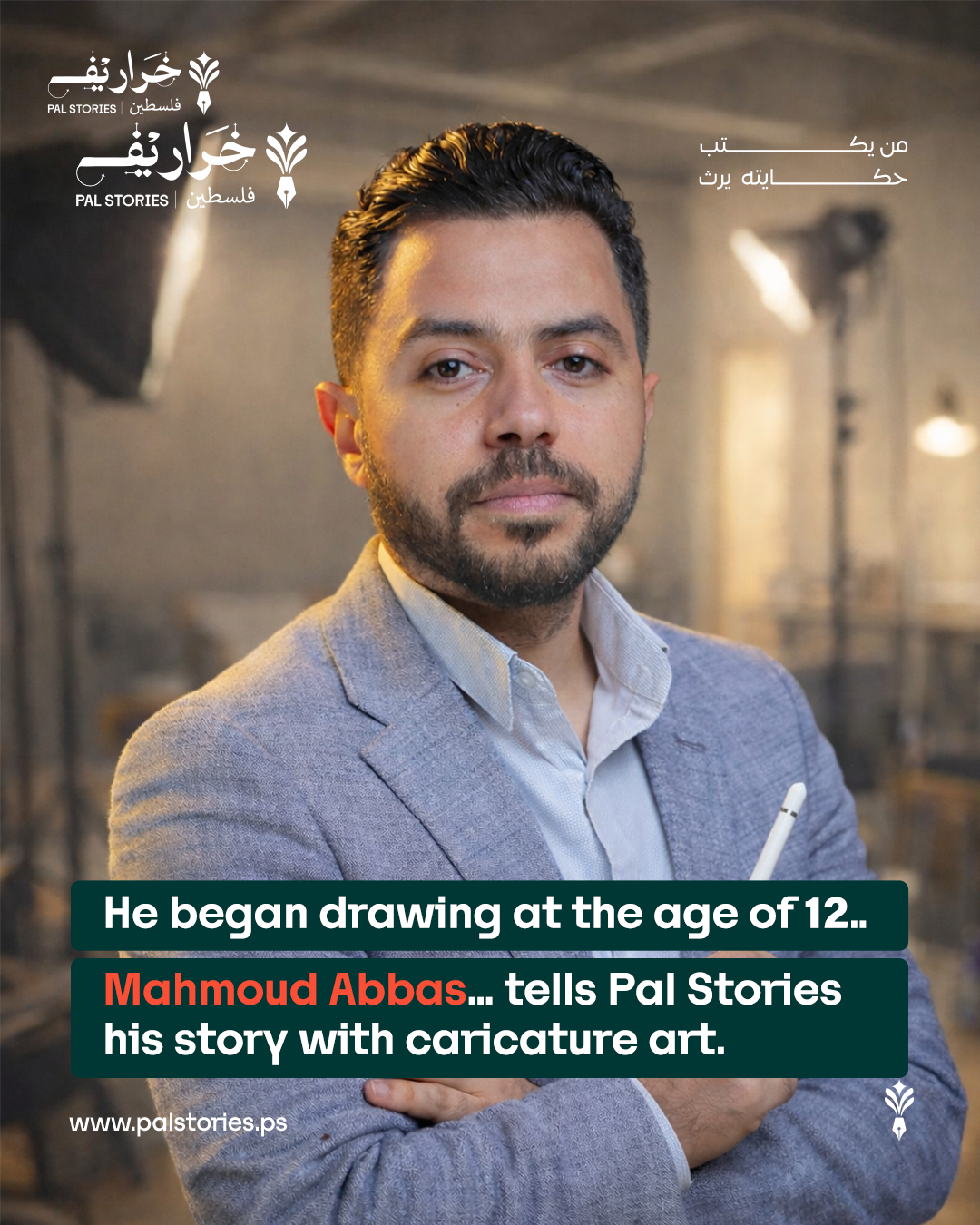
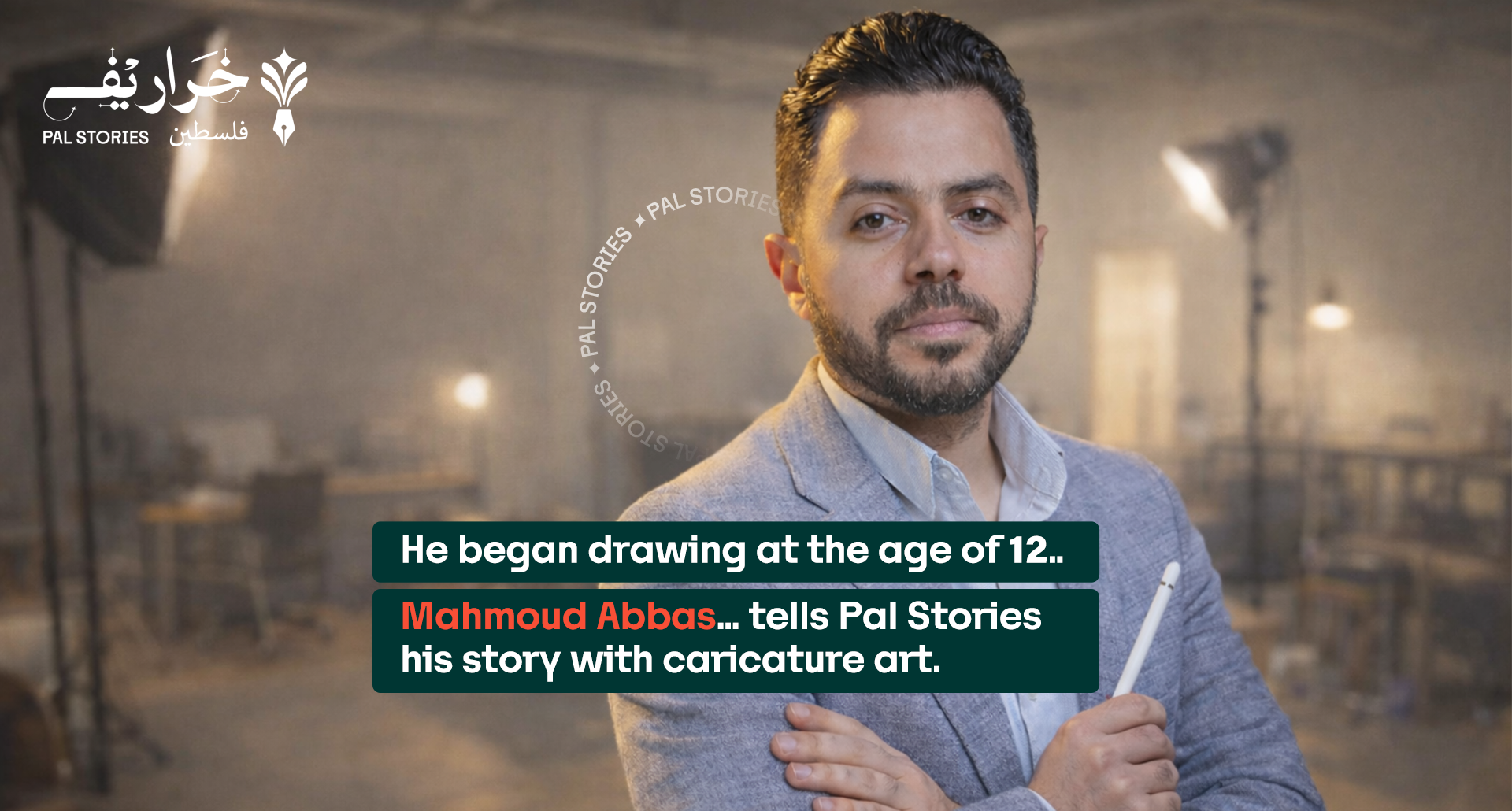
This is how Gaza-based cartoonist Mahmoud Abbas describes himself. He says, “My mother tells me that when I was just one year old, I would cry if I saw one of my brothers doing his homework, just so I could hold the pen. Today, when I see my young son doing the same thing, I understand myself better. Some children are born with a pen in their hand before they even know its name. That’s how I grew up, drawing and writing without interruption.”
I first came to know Mahmoud through his activity on social media. He was always present, especially on issues related to Palestine, and Gaza in particular. His name, which he shares with the Palestinian president, also sparked curiosity and drew more attention to his work as a cartoonist.
Since childhood, Mahmoud says, his teachers and classmates affectionately called him “Abu Mazen.” Later, when he grew up and traveled to Europe, introducing himself often prompted smiles and jokes “Mr. President,” some would say.
Where did the story begin?
In Palestine, talent is rarely discovered in conventional ways, like a teacher being surprised by a student’s drawing in class. Nothing here unfolds normally. We resemble our country in every sense. Palestine has never lived a “normal” chapter in its history, and neither have its people.
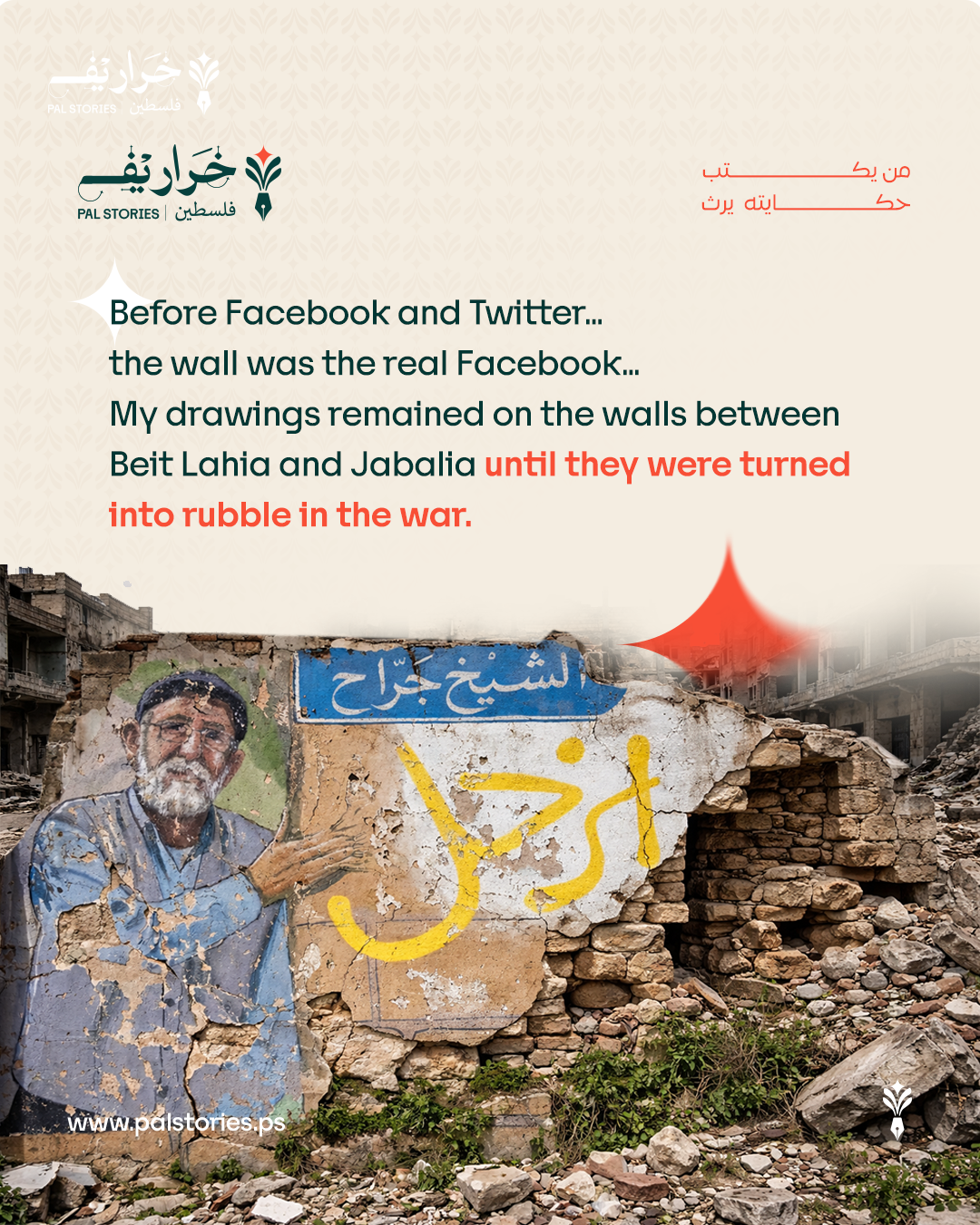
Mahmoud discovered his talent on the walls stretching from Beit Lahia to Jabalia during the Second Intifada in 2000. “Before Facebook and Twitter,” he says, “walls were our only means of communication. The wall was the real Facebook.”
He didn’t sign his name, but over time people began to recognize his handwriting. At just 14 years old, he was writing martyr obituaries, announcing strikes, posting statements, and publicizing events, his handwriting becoming his signature.
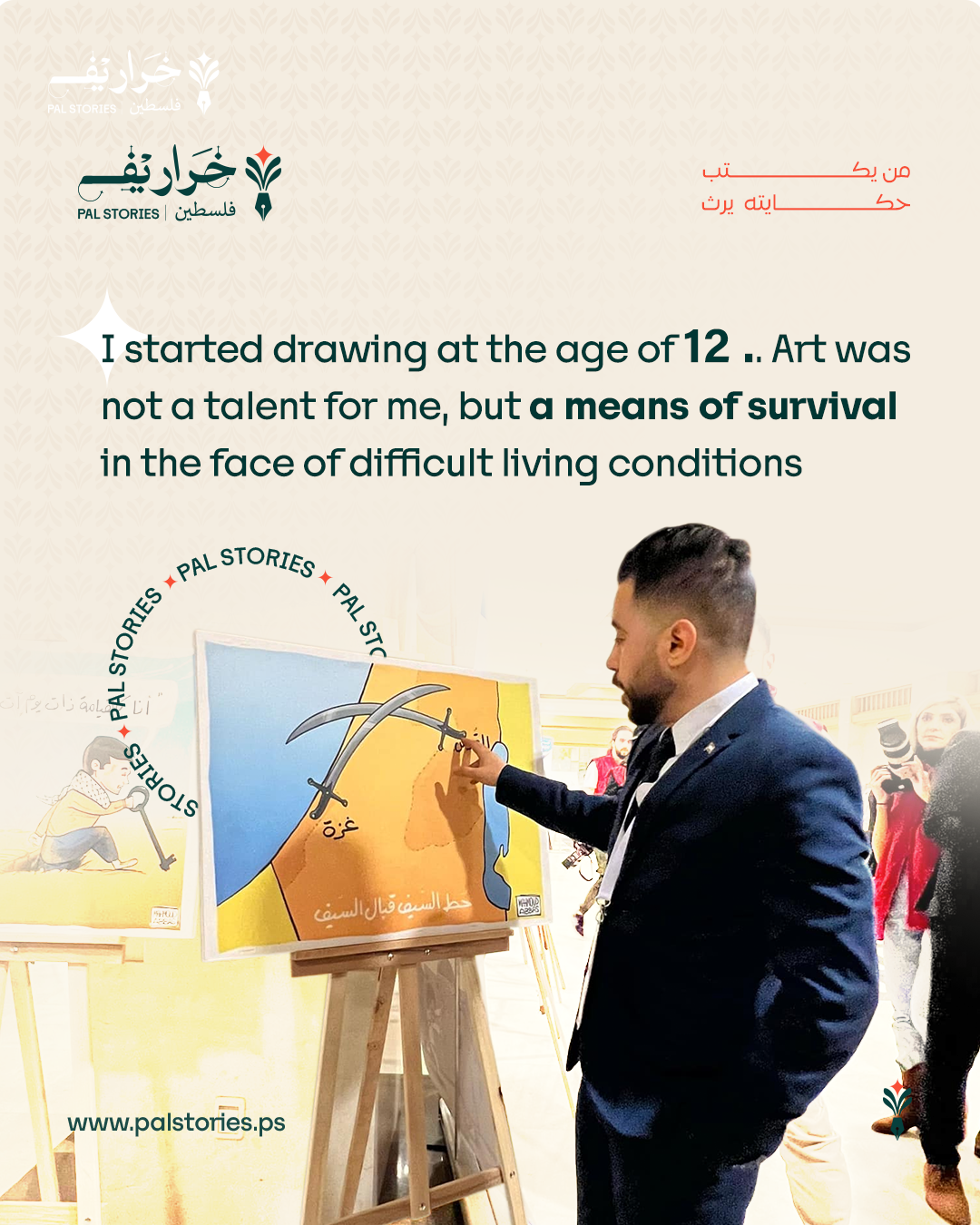
What many might find surprising is that Mahmoud had already been practicing art at the age of 12. He went from library to library, offering to draw educational posters, diagrams of the nervous system, the skeleton, and other school materials, charging half the price of professionals simply because he was a child.
“I wasn’t ashamed of working with my talent,” he says. “I was only ashamed that I couldn’t afford paints. Art supplies were scarce and expensive. I come from a large family with limited income, so I started working early to keep my talent alive.”
Art as a means of survival!
For Mahmoud, art was never just a hobby, it was a way to survive and cope with the harsh realities of life in Gaza.
He later studied design and editing at universities in Gaza, where his national and human consciousness began to take shape, and where he established his first real connection with the world. His work evolved from visual art into caricature.
The 2008 war on Gaza marked a profound turning point. Mahmoud lost his brother Mustafa, then his brother Hussein, and then his father, three members of his family in a short span of time. Yet he refused to let grief silence him. Instead, he redirected his pen, turning it into a tool of resistance and steadfastness, not merely artistic expression.
“At the same time,” he says, “the world itself was changing. Social media, digital drawing, tablets, and stylus pens were emerging. Cartoonists no longer needed newspapers to adopt them. We could build an entire platform on our own pages. That’s when my journey as a cartoonist truly began.”
Cartoons: an idea before an art form
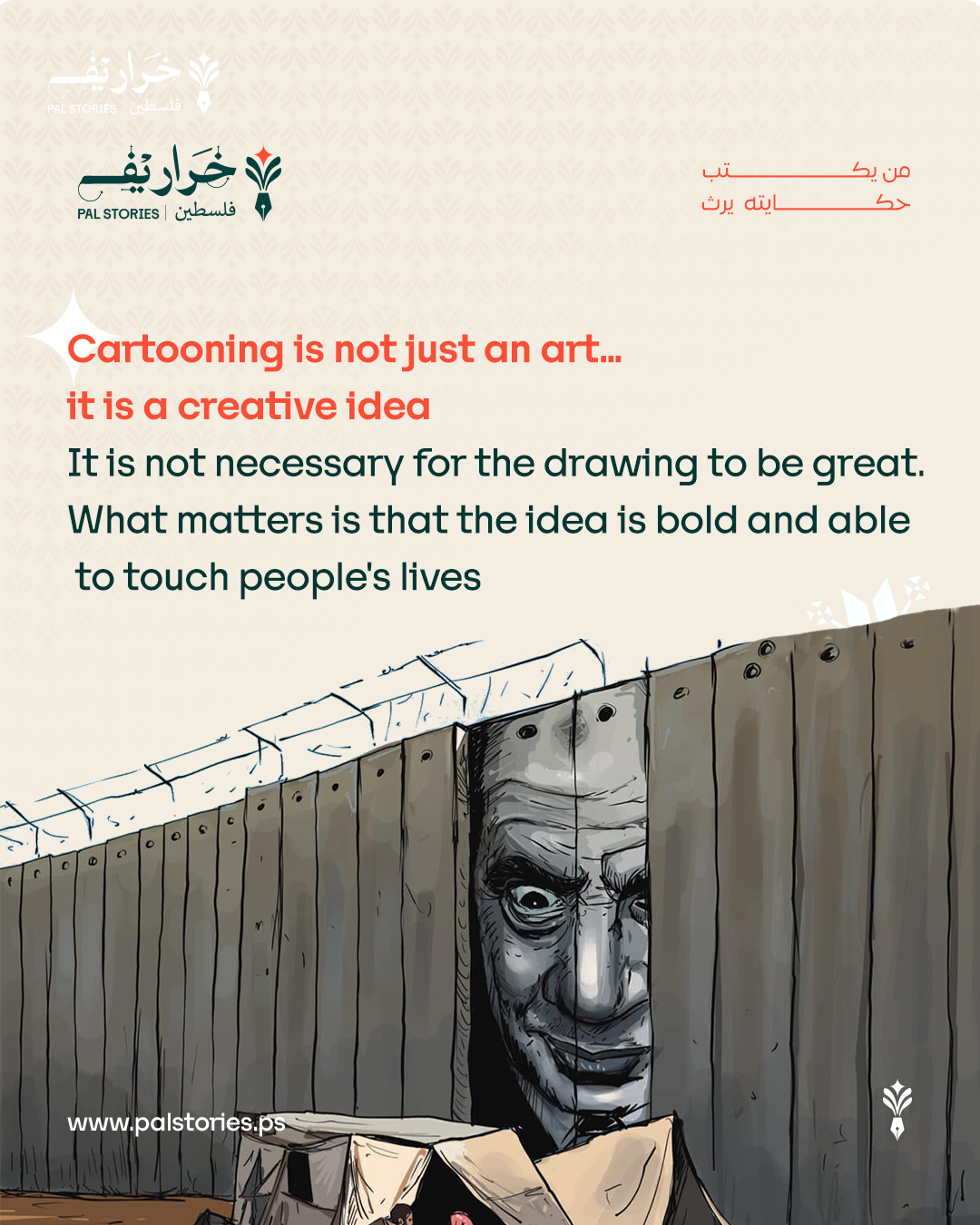
Asked what caricature means to him, Mahmoud responds simply: “Cartooning is not just an art form, it’s an idea.”
A cartoonist, he believes, must be politically, socially, and humanly aware. “A good drawing doesn’t need explanation, but it explains itself.”
“The drawing doesn’t have to be technically perfect,” he adds. “What matters is that the idea is clear, bold, and able to reach people’s hearts. Some of the greatest caricatures were nothing more than simple lines, but their ideas were immense.”
His words inevitably bring to mind the work of the late Palestinian artist and political critic Naji al-Ali. His drawings were visually simple yet sharp in meaning, carrying a clear moral and political stance.
Who can forget Handala, the barefoot refugee child, hands clasped behind his back, turning away from the world? Handala was never a decorative figure. He embodied rejection, awareness, and an uncompromising memory, transforming caricature into a conscious, human visual language. His power lay not in form, but in the ideas that unsettled authority and spoke directly to people.
Europe… and a wider space of freedom
Mahmoud left Gaza in 2012, discovering for the first time that the world was far larger than what Gazans could see from inside their confined reality.
“In Gaza,” he says, “we thought everyone lived like us, that electricity cuts were normal everywhere, that movement always required permits.”
Leaving Gaza revealed to him the scale of injustice imposed on its people and allowed him to see Palestine, “the land of fog”, with greater clarity.
In Europe, his horizons expanded. He became more connected to global struggles and more attuned to the suffering of other peoples, integrating these concerns into his work.
Mahmoud and I share the belief that Palestinians are among the most humane and empathetic peoples, precisely because of the pain they have endured through successive occupations. This history has sharpened their sensitivity to injustice everywhere.
For Palestinians, principles are indivisible. Fighting occupation at home means rejecting oppression everywhere, opposing colonialism in all its forms, and standing instinctively with oppressed peoples worldwide.
The freedom of expression Mahmoud encountered in Europe allowed him to raise the ceiling of his work, criticizing regimes, normalization, and government policies, not for provocation, but out of commitment to human rights. His cartoons reached millions around the world.
Threats and persecution
“But some cartoons came at a high cost,” Mahmoud says. “Threats, smear campaigns, and deliberate misinterpretations.”
The most severe incident occurred in 2020, when he published a cartoon about the collapse of oil prices during the COVID-19 pandemic. The drawing went viral in Saudi Arabia, prompted official statements, and resulted in direct threats to his life.
Still, Mahmoud refused to apologize. “An apology would have meant admitting to a mistake I never made.”
Genocide… and a return to humanity
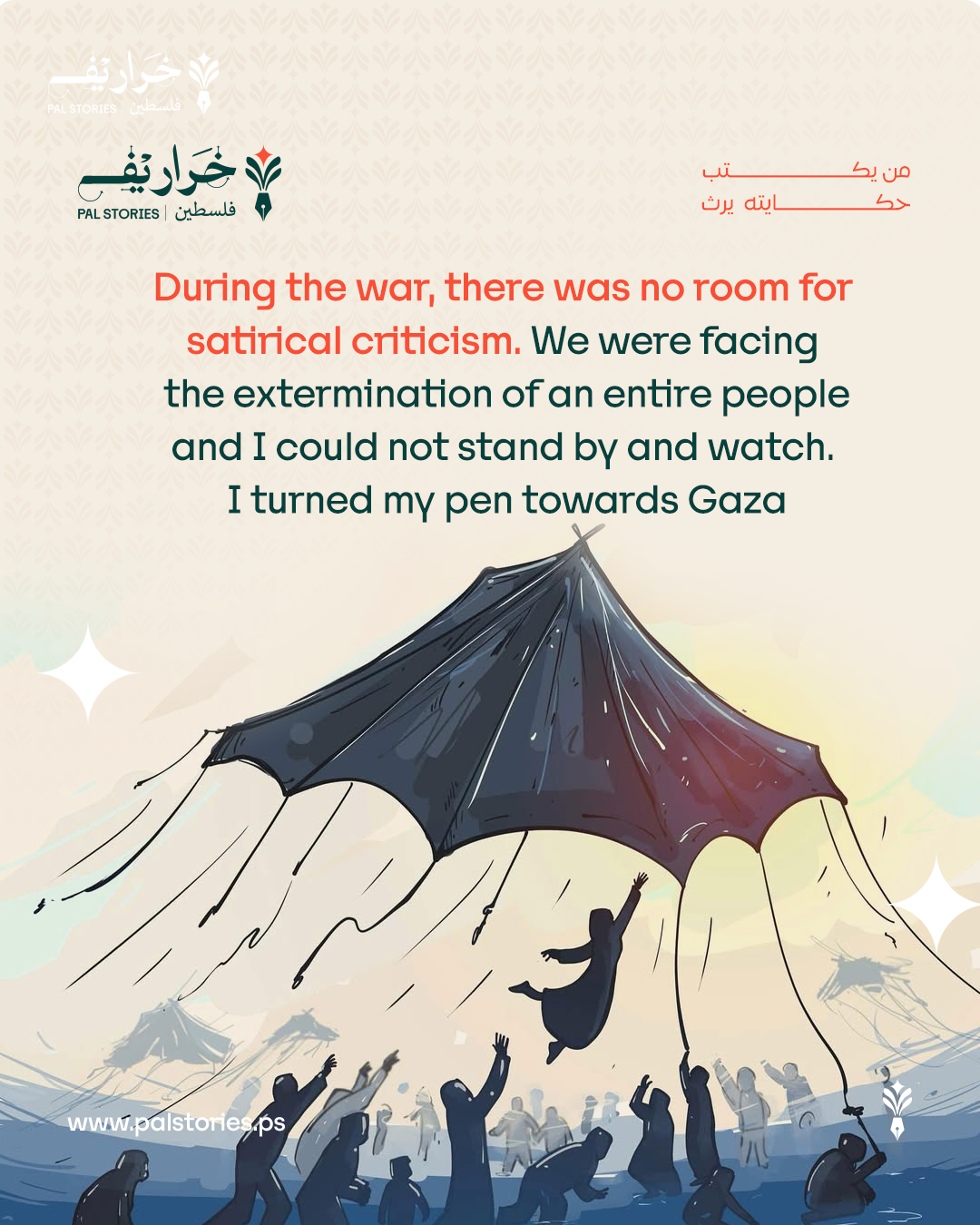
Caricature often relies on satire and critique, but during the latest war on Gaza, Mahmoud says, satire lost its place.
“We were facing genocide, an army backed by the most powerful countries in the world against a defenseless people. I chose the humanitarian side.”
“If I don’t stand with my people now,” he adds, “then everything I’ve done in my life would be meaningless.”
Through his large online following, Mahmoud turned his platforms into spaces to amplify Gaza’s pain, demand justice, and call for an end to extermination. Gaza, the place he left but never truly left, still carries his story on every street, his graffiti etched into its walls.
Mahmoud is a father of three sons and a daughter. His daughter, Reem, has clearly inherited his artistic genes. He encourages her talent, buys her art supplies, and occasionally shares her drawings online, where thousands show their support.
Yet he refuses to let fame consume her at a young age or allow her to create her own platforms. “I want my children to grow up freely and naturally,” he says. “They don’t have to become artists. It’s enough that they understand art can be a human position, something people believe in, defend, and sometimes pay for throughout their lives.”
Mahmoud Abbas has never lived a life of ease, or even a normal one. From writing on walls, to war and the loss of three family members, to forced displacement due to Gaza’s unlivable conditions, to persecution for his art and political stance, his life mirrors that of the ordinary Palestinian, who continues to pay the price of identity wherever they go.