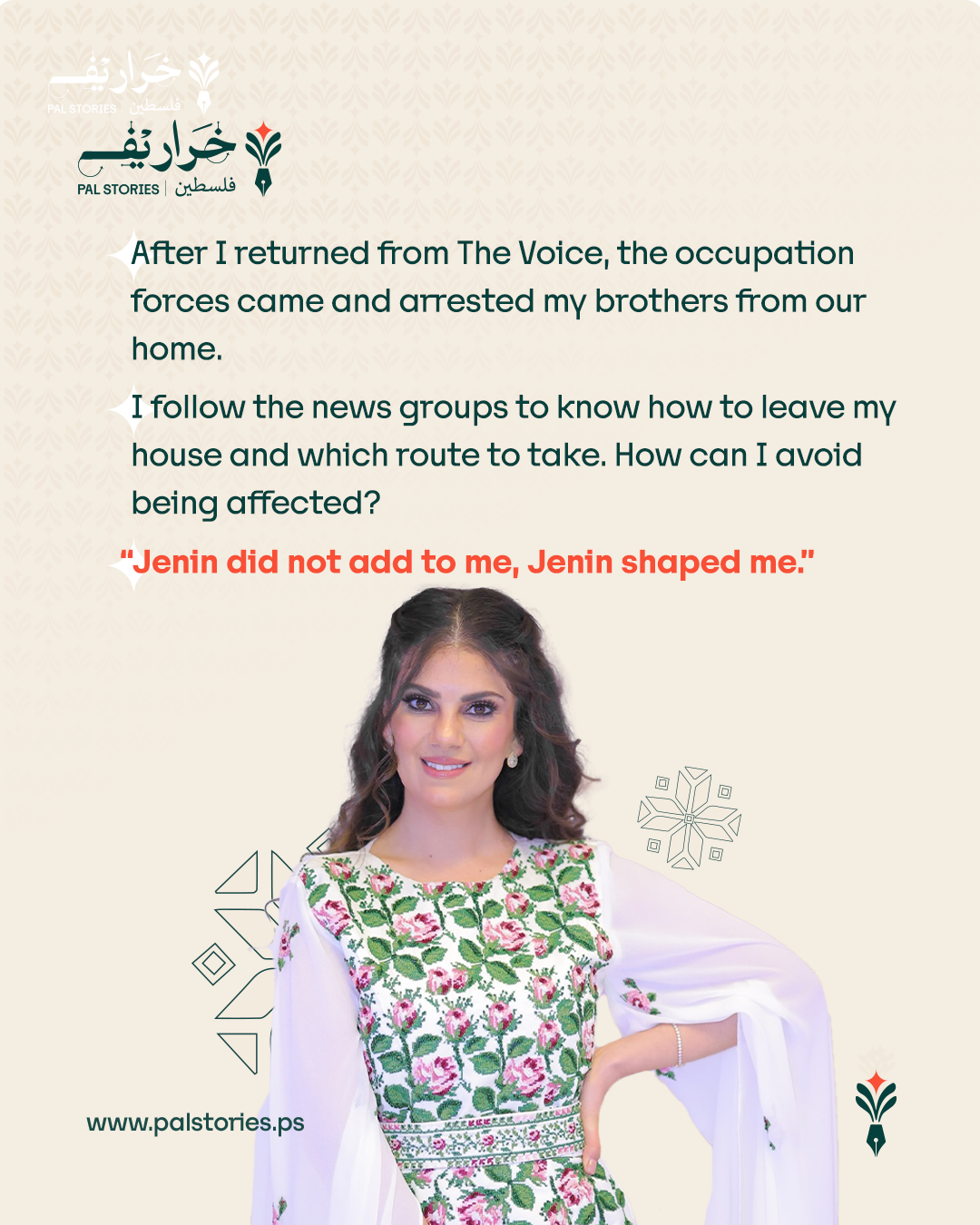
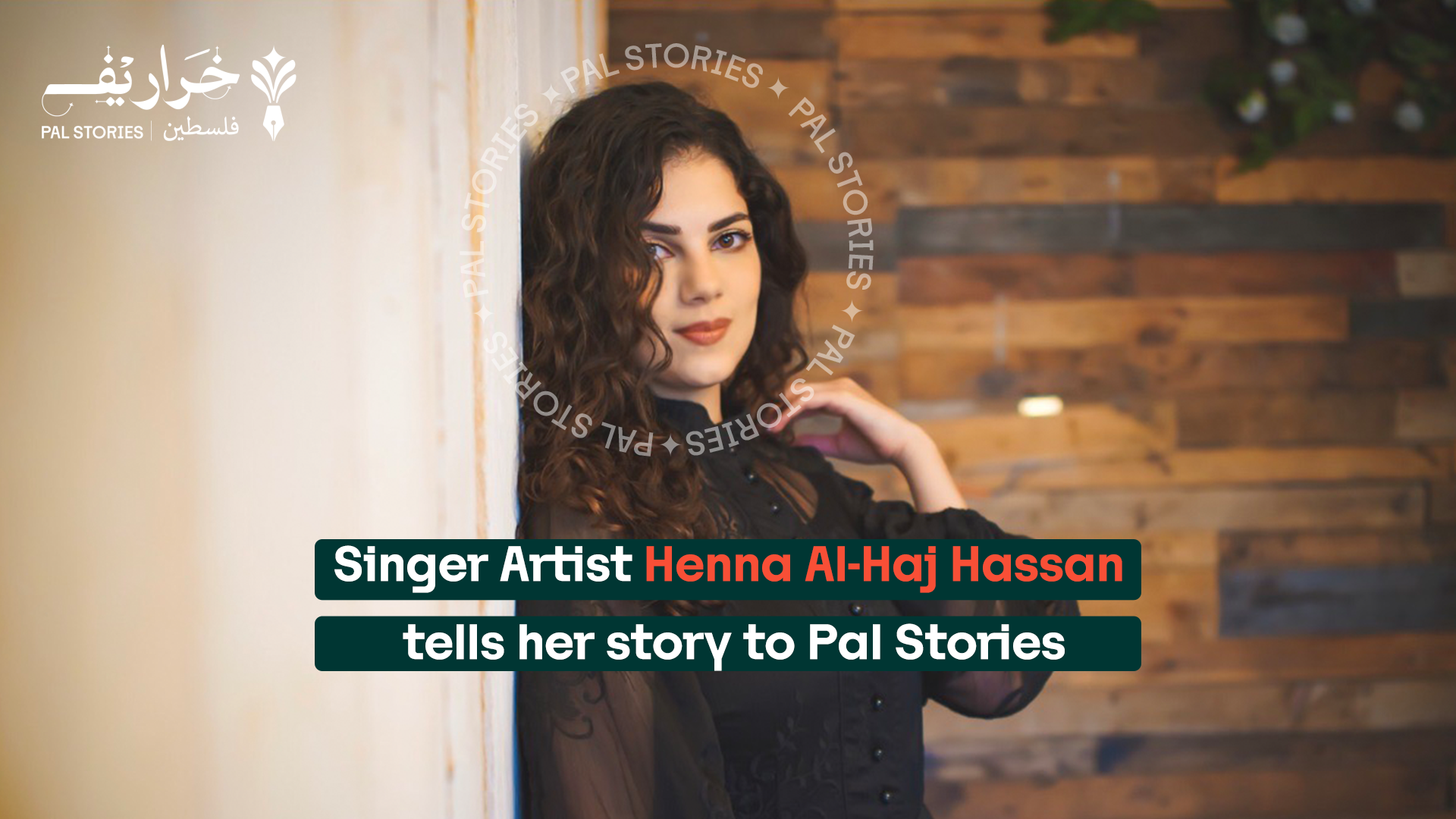
“Jenin didn’t add to me, Jenin shaped me.”
With this statement, Henna summed up her relationship with her city, Jenin, where she was born, raised, and lives. The city, which she feels is marginalized and oppressed compared to other Palestinian cities, did not add to her, but rather shaped her to be who she is today, “Henna.”
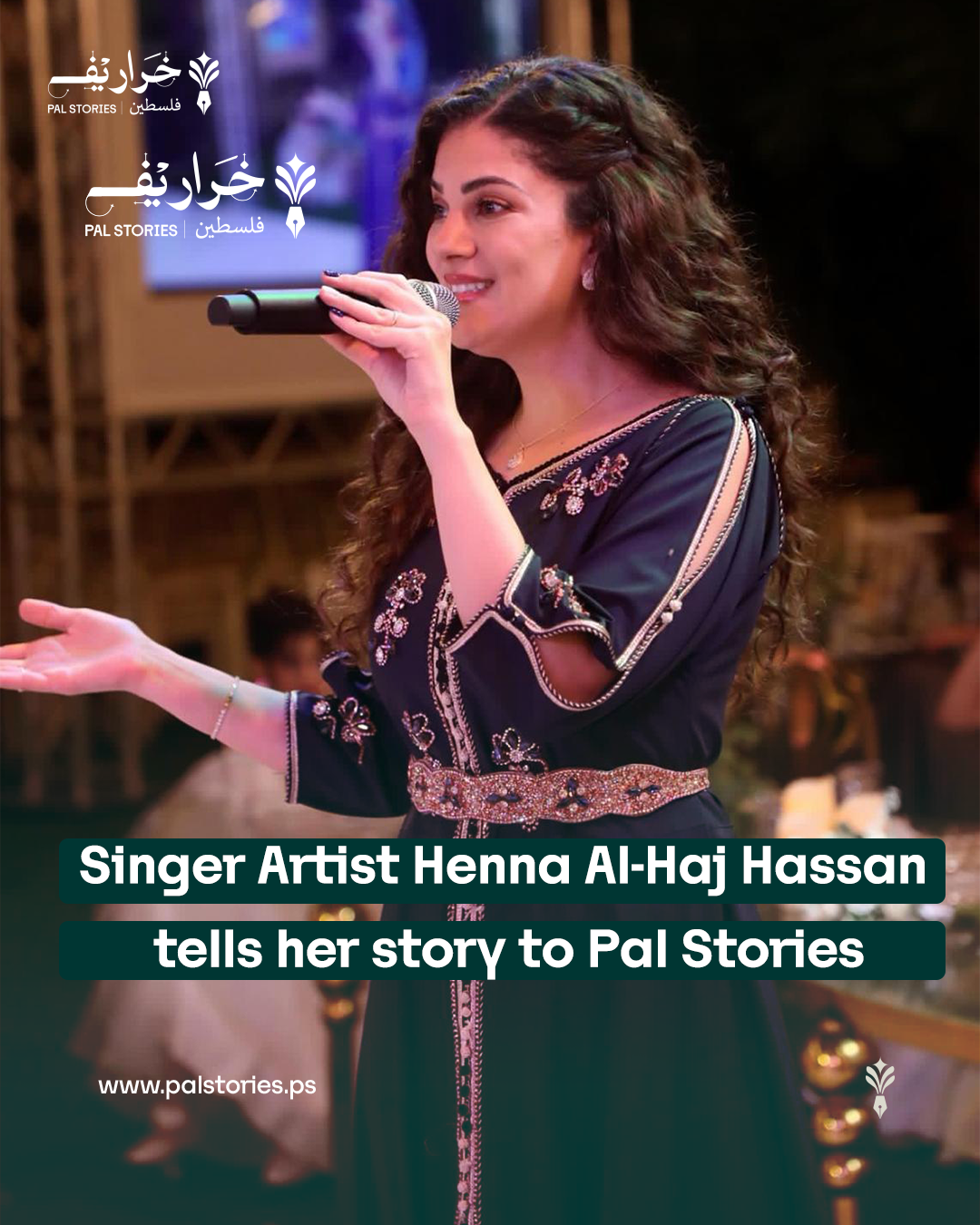
Just a few weeks ago, artist Henna Al-Haj Hassan appeared on Arab television wearing a beautiful Palestinian dress, performing a medley of Asmahan’s song “Ya Deirti” and the traditional song “Marmar Zamani”. It was like a complete work of art presented on the stage of the famous Arab program The Voice.
Henna says she was preparing to go to France for an artistic residency when the program’s team contacted her via her Facebook page and suggested she apply, perhaps because her page clearly reflects her Palestinian artistic identity.
Due to the political situation in Lebanon, this season was filmed in Jordan. Henna explains that her real joy was not only appearing on Arab television, but also that people outside Palestine recognized her talent and interacted with the song she sang. She notes that when the episode aired, she was watching the judges’ reactions, especially Ahmed Saad, who is closest to her singing style.
Despite the importance of The Voice to Henna, as it took her from local fame to Arab fame, her story with singing did not begin with the program, but rather when she was a child in school, before her talent took on a professional form when she entered university in 2011.
I still remember how students would gather around Henna, forming a beautiful circle, whenever she sang with her beautiful voice on the steps of the Faculty of Media at Birzeit University. Hanna is a fellow student who specialized in radio and television, a field she says she never found herself in, as she has been a lover of melody and music since she was a child.
Alongside her studies in radio and television, Henna continued to develop her talent for singing by enrolling at the Edward Said Conservatory. At that time, she had opportunities to sing at popular events and festivals, sing with the Revolution Choir, and record her voice for various dabke bands, which made her talent a source of livelihood.
Despite obtaining a degree in media, she did not find herself there and kept asking herself: What field suits me? When the music program opened at Birzeit University, she decided to go back and study for a bachelor’s degree in music, where she finally found herself. She says that studying at an older age, when you know what you love, is more beautiful, more conscious, and more responsible.
Returning to the topic of Jenin, it was clear how much this resilient city had left a cultural and national impact on Henna. On the one hand, it made her more connected to humanitarian and national issues, not only Palestinian ones, but all issues of justice for peoples. On the other hand, the reality of the city, its ongoing siege, and the daily attacks it is subjected to by the occupation forces were reflected in her singing experience, which was characterized by its authentic folk and national style.
How could an artist who follows the conditions of the roads and locations of incursions in the city on social media groups called “neighborhoods” as she described them, in order to be able to draw her own daily road map, forget that, while she produces her art and presents it to the public? The reality of the city is what shapes the lives of its people and determines their work and movements, and Henna is a daughter of this reality and an integral part of her life.
Even after her return from The Voice, the occupation forces had driven her brothers from their homes, like thousands of people whom the occupation had displaced from their homes in the northern West Bank, numbering nearly 40,000 according to statistics from various sources.
Despite all of the above, what bothers Henna the most is the perception of Jenin as a “dark” city devoid of art in all its forms, as this stereotype is completely untrue.
Although Jenin did not have a large number of cultural and artistic centers, it has historically been distinguished by its oral and folk art: from singing in homes to weddings, and even in the fields, where mawawil (traditional songs) were sung by farmers during the planting and harvesting seasons. This means, in one way or another, that art in Jenin was not produced to be exhibited, but to be lived.
Although the stereotypical image of Jenin is that of a city in clashes with the occupation forces, it has produced musicians who have revived its heritage, great artistic experiences that blend the popular with the modern art, and artists who have broken the idea that art is a luxury or a departure from the “conservative environment.” Jenin has produced artists without large institutions, but with a high culture and an authentic voice, creating a sincere, unpretentious style that is close to the people, much like the land from which it emerges.
Since the first intifada until today, art in Jenin has been directly linked to political action. At every stage of the struggle, there were chants, national and folk songs, zajal, street theater, and poetry. Later, rap emerged as an alternative form of expression from the camp. Art in Jenin is historically an act of resistance and steadfastness, and is not something new to it.
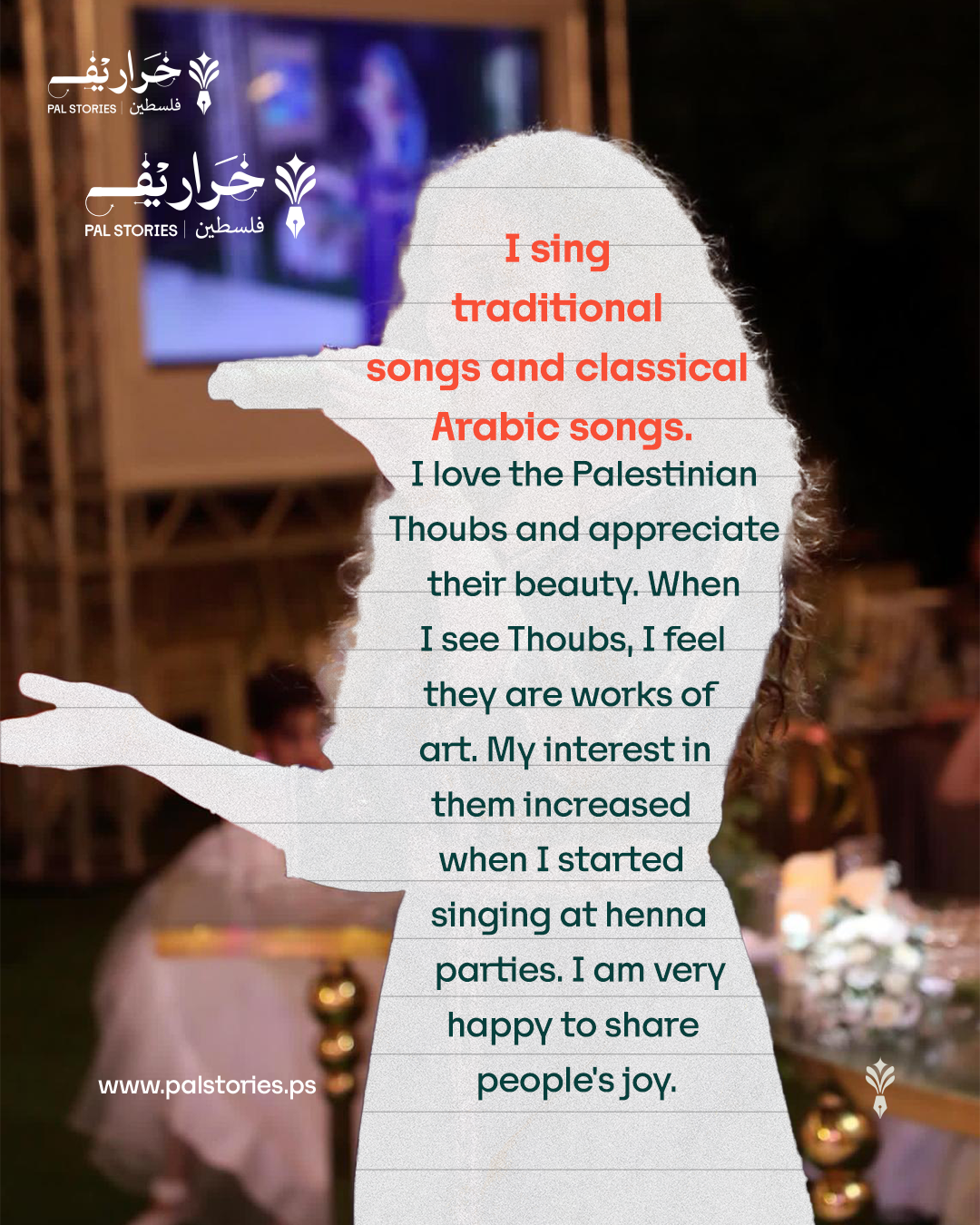
Over the past few years, Henna has become known to the Palestinian and Arab public for the traditional art she presents at Henna ceremonies in Palestine. She wears her beautiful Thoub and shares people’s joy with their daughters in one of the most beautiful Palestinian traditions, from which Henna derives her name. While the celebrants recall the memories of our ancestors by drawing henna on the bride’s hands and bidding her farewell before she leaves her family home to start her new life, Henna’s voice accompanies them in this joyful traditional event, creating a cheerful image that tells the world: Palestinians love joy and love life.
One of the most important milestones in her life was her work with the Nawa Foundation in collecting and archiving the voices of Palestinian singers from before 1948, names that are unknown in Palestine but well known in Lebanon and the diaspora, which added to her artistic culture, alongside her talent.
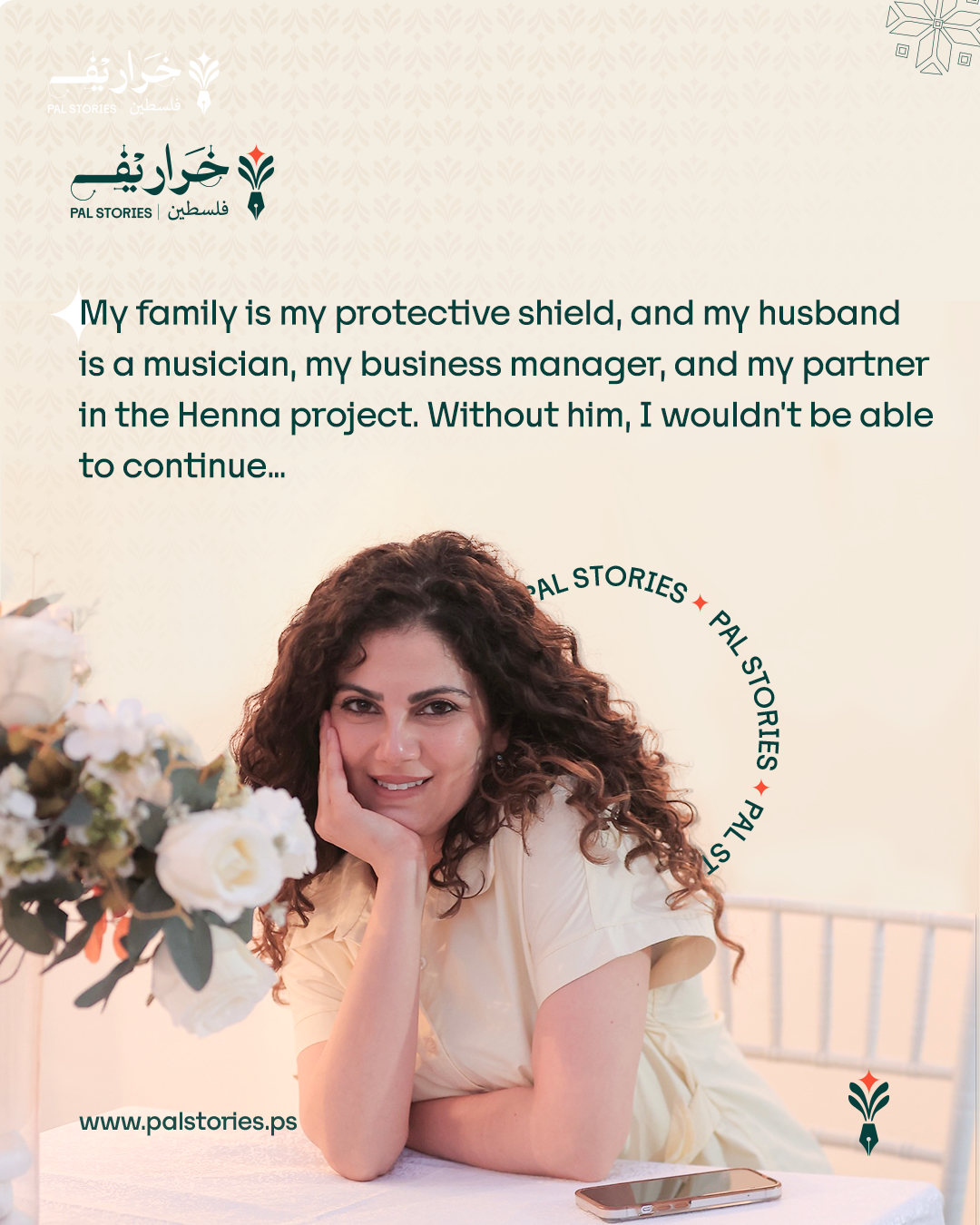
I asked her if she had faced any pressure or criticism, especially since she lives in a conservative society that does not readily accept girls as singers. She replied, “My family is my protective shield.”
She pointed out that she grew up in a supportive environment, with a confident father, and a home that did not differentiate between girls and boys. They are three brothers and two sisters who have full freedom of choice in everything related to their personal lives. Even if not everyone likes it, they always do what they think is right. Therefore, she has always been confident in every step she takes and believes that any Palestinian art presented professionally is an achievement in itself.
Just as he appeared behind the scenes of the program, delighted and proud of her success, so is her husband, who is always by her side. He is a musician and academic director at the Kamanjati Association, her business manager, and her partner in her artistic project, Henna. He takes care of the administrative aspects and supports her in her songs and artistic planning. She says clearly that she cannot continue her project without him.
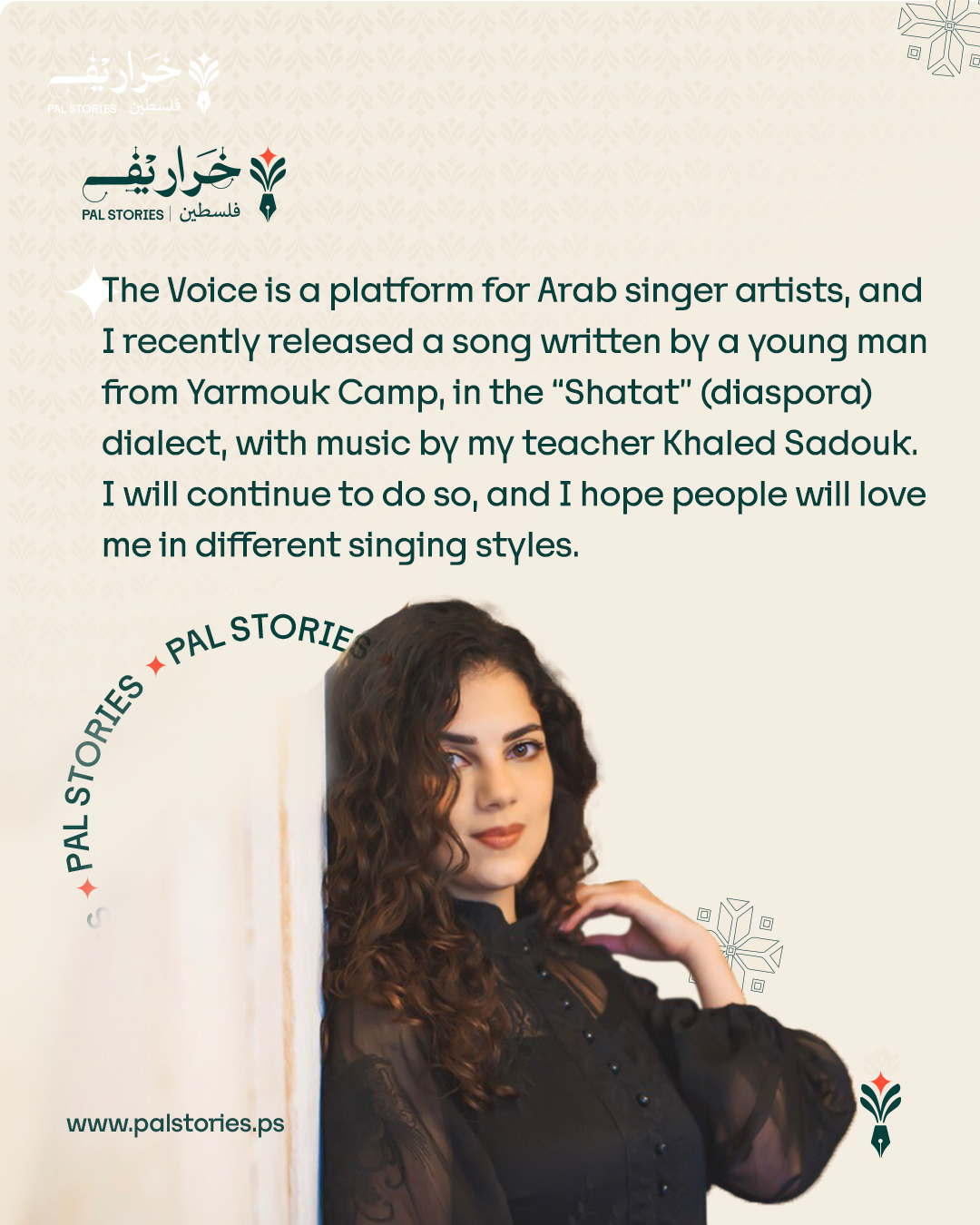
Recently, she released a special song written by a young man from the Yarmouk camp, in the “Shatat” (refers to diaspora) dialect, which she heard for the first time. The melody was composed by her teacher Khaled Sadouk. The song tells the story of a son’s feelings towards his mother, similar to the story of any Palestinian refugee or person stuck in their country.
For her, The Voice was not a quest for a title or a competition, but a means of spreading her music. After the experience, she began new collaborations and sought out styles she had not sung before. Although she affirms her love for her heritage, she does not want to limit herself to it; she wants to try other styles of singing.